There’s a quiet authority to an aircraft blueprint.
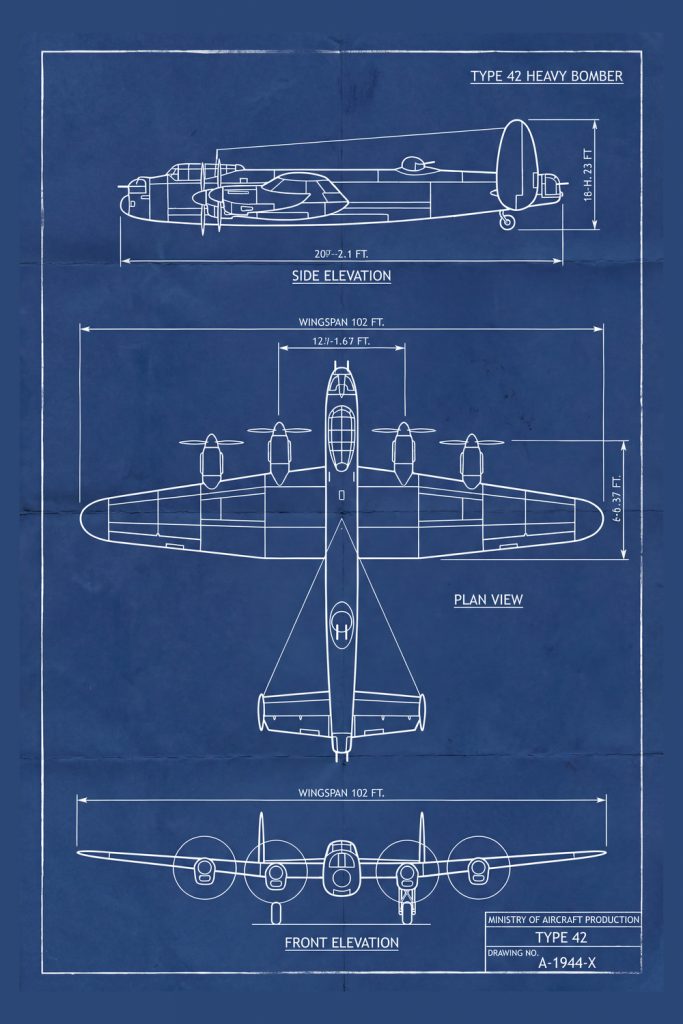
Stripped of camouflage, markings, and mythology, what remains is pure intent: form, scale, and function. This technical drawing of the Type 42 Heavy Bomber, produced in 1944, captures that moment where aviation was engineered not for elegance—but for range, payload, and endurance.
Rendered in classic blueprint style, the drawing presents the aircraft from three essential perspectives: side elevation, plan view, and front elevation. Together, they tell the complete story of the machine.
The numbers alone are revealing. A 102-foot wingspan, multi-engine configuration, and long fuselage designed to carry crews, fuel, and ordnance across vast distances. Every line serves a purpose:
- Broad wings for lift and stability
- Multiple engines for redundancy and power
- A fuselage designed around crew stations and internal systems
- Tail geometry optimized for control at altitude
This was aviation designed with slide rules, drafting tables, and field experience—not simulations.