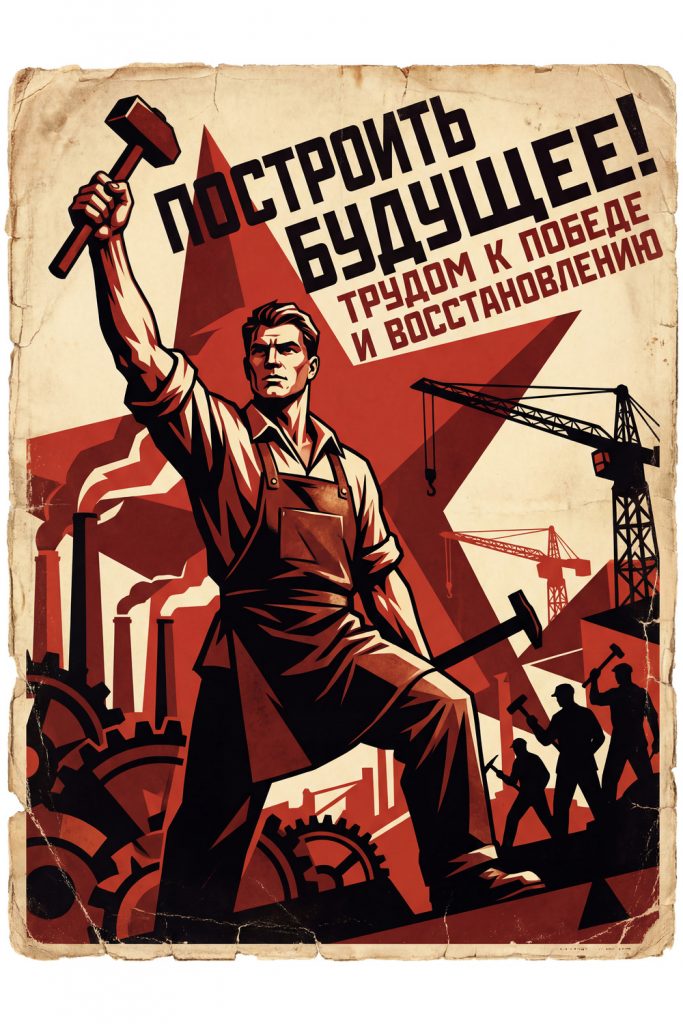
This image is a striking example of Soviet reconstruction-era poster art, a visual language built to communicate strength, unity, and relentless forward motion in the aftermath of war and industrial upheaval.
At the center stands the archetypal worker—hammer raised, body anchored, gaze fixed forward. He is not depicted as an individual, but as an embodiment of labor itself. Around him, factories rise, cranes swing into motion, gears turn, and silhouettes of fellow workers advance in unison. Every element reinforces a single idea: rebuilding through collective effort.
The bold red star, heavy angular forms, and limited color palette are deliberate. This is art designed for instant comprehension from a distance—meant to be read in seconds, not studied quietly. Soviet posters were mass communication tools, merging graphic design with ideology, engineered to motivate, instruct, and inspire.
During the reconstruction period, posters like this played a critical role. They weren’t decorative; they were instructional and symbolic. They framed labor as heroic, industry as noble, and rebuilding as a shared national mission.
Key visual themes include:
- Heroic scale — workers depicted larger than life
- Upward motion — diagonal lines, raised tools, forward stances
- Industrial motifs — gears, cranes, smokestacks
- Unity over individuality — figures act as a collective force
- Red and black contrasts — urgency, power, resolve
This was propaganda in the purest historical sense: not subtle, not ironic, but visually commanding.