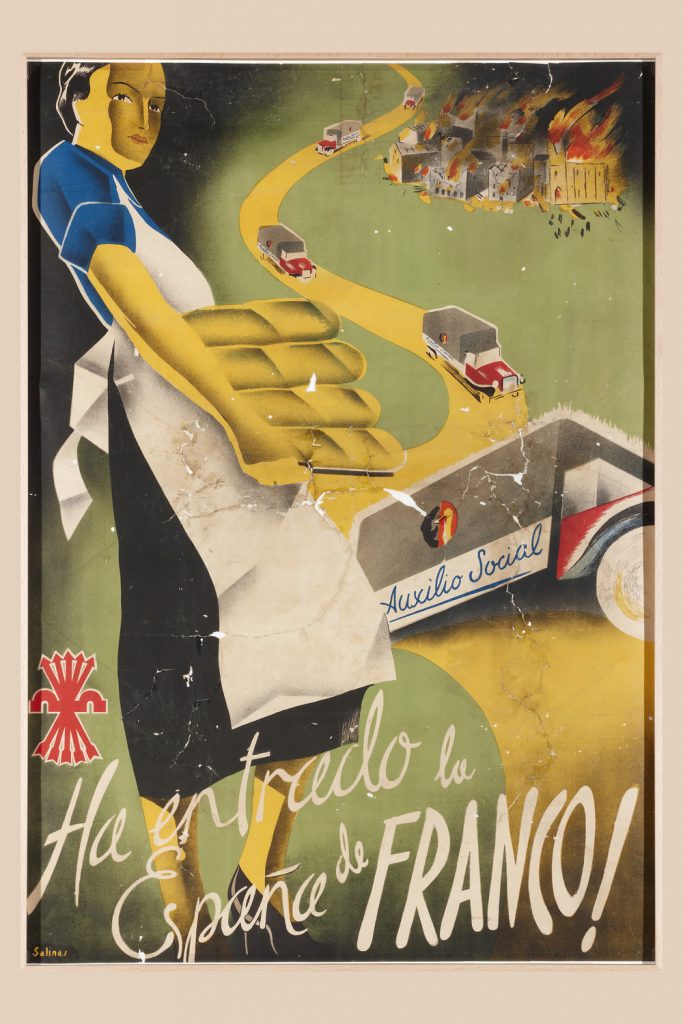
In the visual history of the Spanish Civil War, few images are as haunting or as structurally complex as the Auxilio Social (Social Aid) posters. While the Republican side often focused on the collective struggle of the militia, the Nationalist propaganda under Francisco Franco frequently leaned into themes of order, reconstruction, and the “benevolent” restoration of traditional life.
The Symbolism of the Bread
In this striking 1930s reproduction, the artist Salinas uses a motherly figure to anchor the composition. Clad in a simple apron and carrying a mountain of large loaves, she represents more than just food; she represents the promise of stability after the scorched-earth chaos depicted in the background.
Notice the yellow road winding away from the burning city—it’s a path of “deliverance” traveled by the Auxilio Social relief trucks. The message was clear to a war-torn population: Where the España de Franco enters, the hunger ends.
The Artist: Salinas and the Falange Style
The illustrator Salinas was a master of the “Social Realist” style adopted by the Falange (Spain’s fascist party). Look closely at the bottom left, and you will see the Yoke and Arrows (Yugo y Flechas), the ancient symbol of the Spanish Catholic Monarchs adopted by Franco’s movement.
The aesthetic is clean, modernist, and highly effective:
- The High-Contrast Glow: The woman is bathed in a halo of light, contrasting with the dark smoke of the ruins.
- The Movement: The sweeping S-curve of the road draws the eye from the tragedy of the past (burning buildings) to the “abundance” of the present.
- The Typography: The script is fluid yet authoritative, designed to feel like a definitive announcement.
Why It’s a Collector’s Essential
For historians and collectors of 20th-century political art, the “Franco’s Spain” posters are vital for understanding the war of images that defined the 1930s. This piece doesn’t just show a political shift; it shows how a movement attempted to win “hearts and minds” through the promise of basic necessities.
Whether displayed as a study in mid-century graphic design or as a somber reminder of a divided Europe, this print remains one of the most visually arresting examples of the Nationalist aesthetic.