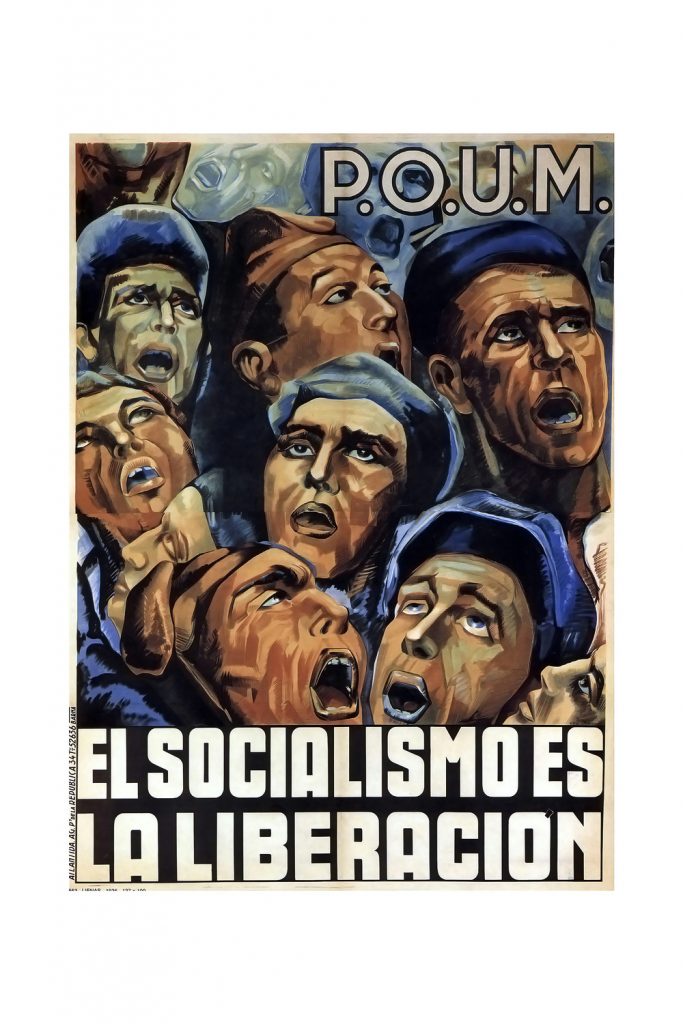
Who were the P.O.U.M.?
The Partido Obrero de Unificación Marxista (Workers’ Party of Marxist Unification) was a revolutionary socialist party that became legendary for its fierce independence. While the world watched Spain as a battleground between democracy and fascism, the P.O.U.M. fought for a third path: true worker-led social revolution.
Literary Giants in the Trenches
While Ernest Hemingway was famously reporting from the Hotel Florida in Madrid and Pablo Picasso was immortalizing the tragedies of war in Paris, another titan was actually on the front lines with the P.O.U.M.: George Orwell.
Orwell joined the P.O.U.M. militia as a volunteer. His experiences—from the boredom of the trenches to the betrayal of the group by Stalinist forces—formed the basis of his masterpiece, Homage to Catalonia. When you look at these faces on the poster, you are looking at the same men and women Orwell stood beside in the streets of Barcelona.
Why This Poster Matters Today
The “El Socialismo Es La Liberación” poster is a masterclass in Constructivist-influenced graphic design.
- The Palette: The use of muted blues against earthy skin tones creates a sense of grounded, human struggle.
- The Perspective: The “Low Angle” view makes the subjects appear heroic and monumental, a hallmark of 1930s political art.
- The Message: It represents a time when art was the primary tool for mass communication and mobilization.
Bringing History Into Your Space
Whether you are a collector of Spanish Civil War history or a lover of bold vintage typography, this reproduction brings a sense of gravity and intellectual history to a room. It pairs perfectly with minimalist furniture, allowing the rich, historical narrative of the 1930s to take center stage.